;)


Why cybersecurity doesn’t end when IT equipment is decommissioned
Cybersecurity is often associated with protecting active IT systems. Firewalls, threat detection systems, encryption, access controls, and regular software updates are essential components of an organization’s security strategy. Yet one important question is often overlooked: What happens to sensitive data when the equipment storing it reaches the end of its operational life?
Servers, computers, hard drives, SSDs, and magnetic tapes do not automatically become security-free assets once they are taken out of service. Sensitive information may remain on these devices long after they are no longer in use. An effective cybersecurity strategy must therefore go beyond protecting data during everyday operations. It should also address what happens when IT equipment is decommissioned, transferred, reused, or disposed of.
Retiring IT equipment doesn’t mean destroying its data
Organizations regularly replace or upgrade their IT infrastructure. Equipment may be retired due to technology upgrades, hardware failures, changes in service providers, or the restructuring of IT environments. Once decommissioned, these assets may be placed in storage, sent for repair, transferred to recycling companies, resold, or prepared for reuse.
The challenge is that removing a device from service does not remove the information stored on it.
Retired storage media may still contain personal data, financial records, customer information, internal business documents, system configurations, or other confidential information. Simply deleting files or performing a standard format does not guarantee that the data has been permanently erased. Depending on the storage technology and the method used, some information may remain recoverable. Even damaged or non-functional devices can retain sensitive information. A hardware failure does not necessarily mean that the stored data is permanently inaccessible. From a security perspective, the key question is not whether the device still works, but whether the information it contains has been securely and effectively erased or destroyed.
What happens between decommissioning and data destruction?
One of the risks associated with retired IT equipment is losing control over storage media before they reach the final stage of processing.
Consider an organization upgrading its data center. Dozens of hard drives are removed from servers and placed in temporary storage while decisions are made about their future. Some may be reused, while others are scheduled for destruction.
Without proper asset tracking and handling procedures, several important questions arise:
- How many storage devices were actually removed from service?
- Where are those devices now?
- Who is responsible for their custody?
- Has each device been assigned to the appropriate process?
- Is there documented evidence confirming that the data on each device was erased or destroyed?
If these questions cannot be answered, the organization may struggle to demonstrate what happened to its information-bearing assets. Security risks are not limited to the destruction process itself. They can also arise during temporary storage, transportation, or the transfer of media between employees, departments, and external service providers. This is why IT asset decommissioning should be managed as a structured, controlled process rather than a single technical operation.
Chain of Custody: why continuous control matters
An important principle in secure media management is Chain of Custody – the documented history of who has handled or controlled a storage device throughout its lifecycle.
In practice, this means being able to establish who was responsible for a particular device, when custody changed, and what actions were performed. A controlled process may include identifying the media, recording serial numbers, assigning storage locations, documenting transfers, managing secure storage and transportation, and recording the final data erasure or destruction operation. This creates a traceable history that allows organizations to review how each storage device was handled and whether the required procedures were followed. Such controls are particularly relevant in environments that process confidential or sensitive information, including financial institutions, government agencies, defense organizations, and critical infrastructure operators. After all, even the most effective data destruction technology cannot compensate for a lack of control over what happened to a storage device before it reached the destruction stage.
Data destruction or datamedia physical destruction?
Not every retired storage device needs to be physically destroyed. The appropriate approach depends on several factors, including the type of storage technology, the condition of the device, and the organization’s information security policies.
Choosing the right method should be based on the organization’s security requirements and risk assessment, rather than simply on the availability of a particular device.
Documentation matters just as much as the process itself
Imagine an organization that has arranged for several hundred hard drives to be destroyed. The destruction process has been completed, but a few months later, an auditor requests information about one specific drive.
Was it destroyed? When did the operation take place? Which method was used? Can the destruction record be linked to that drive’s serial number? If the organization only has a general confirmation that the service was performed, answering these questions may prove difficult. This is why documenting data erasure and destruction activities is an essential part of secure IT asset decommissioning. Depending on the solution and procedures used, records may include device identifiers, operation dates, destruction methods, responsible personnel, process results, and completion reports. Reliable documentation improves transparency, supports audits, and helps organizations demonstrate how their information security policies are implemented in practice.
Data security is not only about performing the right operation. It is also about being able to prove what was done.
ProDevice Ecosystem: managing data security as a process
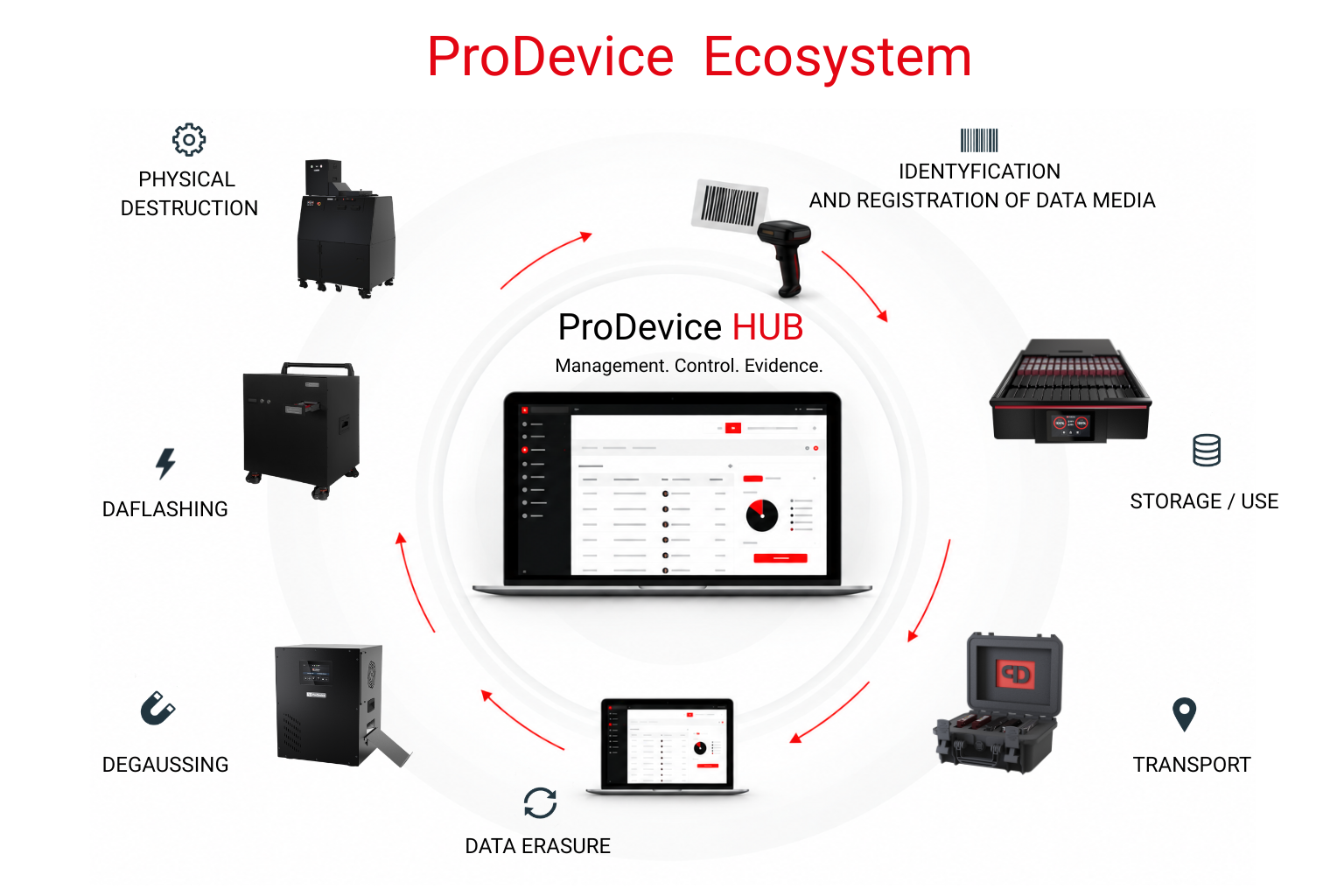
Process-oriented approach is at the heart of the ProDevice Ecosystem. The Ecosystem is designed to bring together the different stages of secure media management — from identification and registration to controlled storage, transportation, data erasure, physical destruction, and process documentation.
The ProDevice portfolio includes technologies for software-based data erasure, degaussing, flash memory destruction, mechanical media destruction, and secure media storage and transportation. Another important element of the evolving architecture is ProDevice HUB, the software layer designed to support media management, workflows, documentation, and Chain of Custody. The scope of integration with individual devices depends on the specific solution and its current implementation stage. By connecting these activities within a structured approach, the ProDevice Ecosystem aims to reduce gaps between individual handling stages and help organizations maintain better control over what happens to their data-bearing assets at the end of their operational life.
Cybersecurity outlasts the equipment it protects
Shutting down a server, replacing a computer, or removing a hard drive from an IT environment does not end an organization’s responsibility for the information stored on that device. As long as sensitive data remains on storage media, unauthorized access or disclosure can still pose a risk — even when the equipment is no longer connected to a network. For this reason, IT asset decommissioning deserves the same attention to security and planning as the deployment and operation of IT infrastructure.
Cybersecurity doesn’t end when equipment is retired. It extends until the risks associated with the data it holds have been appropriately addressed — and the actions taken can be verified.

